
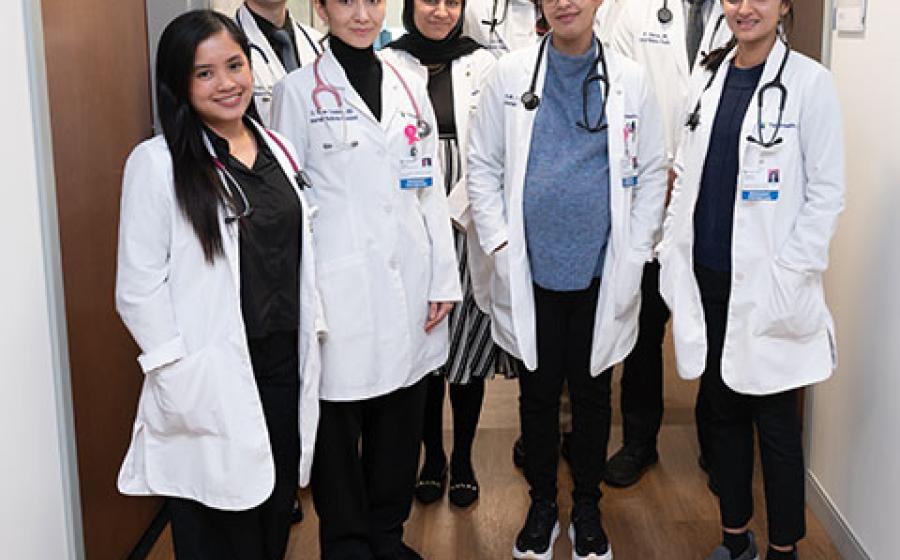
How graduate medical education is strengthening care, expanding training and shaping the future.
TidalHealth is no longer only a place that community members come for medical care. It continues to grow as a teaching system and the benefits of that extend far beyond the hospital walls.
As graduate medical education continues to grow, TidalHealth Peninsula Regional is also strengthening its tertiary and complex care capabilities, bringing more advanced specialty care closer to home for patients and referring practitioners.
The first class of 10 internal medicine residents, who have now graduated, started their journey at TidalHealth in 2022. Currently, there are 90 residents and fellows who are part of graduate medical education programs at TidalHealth.
TidalHealth has six residency and 11 fellowship programs accredited by the Accreditation Council for Graduate Medical Education, or ACGME. Some of TidalHealth’s programs will accept their first learners in 2026, and there’s additional growth planned.
After graduating from medical school, new physicians first complete a residency program and then decide whether they would like to pursue a fellowship for more specialized training. At TidalHealth, they are learning not at just one location, but throughout the health system.
‘A great place to learn’
Alex Daniels, MD, a PGY-2, or post-graduate year 2, resident in the TidalHealth Anesthesiology Residency, has loved her time at TidalHealth so far — the work, her colleagues and the population.
“I really do enjoy coming to work each and every day,” she said.
Being part of the first class of anesthesiology residents has also allowed Dr. Daniels and the other residents to provide feedback and help shape the program. The residency has given her an opportunity to gain hands-on experience and learn how to communicate medical information to patients in a way they can understand.
“This is a great place to learn, to train, to really get that foundation,” she said.
Jack Snitzer, DO, MHA, FACOI, FACE, was involved with TidalHealth Graduate Medical Education before the first residents set foot in the building. Dr. Snitzer is the associate program director for the TidalHealth Internal Medicine Residency and previously served as the program director and as a core faculty member.
He had a role on planning committees about a year before the residency began. Dr. Snitzer and others involved in the program celebrate the learners’ success and want to follow their future careers.
“This is our chance to make a mark on the future — and the community,” Snitzer said.
Five of the first 10 TidalHealth Internal Medicine Residency graduates are still working for TidalHealth. Snitzer has also already had the chance to make an impact on a resident pursuing a future career in endocrinology — his specialty.
Improved care
When attending physicians, the fully licensed doctors who supervise residents and fellows, teach trainees, they are also keeping themselves up to date on the latest knowledge and refreshing their skills, which leads to providing better care, Dr. Snitzer said.
This benefits everyone, from attending physicians to residents and fellows to patients.
“Everybody teaches everybody else,” he said.
Research shows that teaching hospitals improve outcomes, too. A 2017 study in the Journal of the American Medical Association found that major teaching hospitals were associated with lower mortality rates than nonteaching hospitals for several common conditions.
In addition to sharing medical knowledge, attending physicians also teach residents how to talk to and interact with patients, said Nita Hensley, administrative director of medical education at TidalHealth. Hospital patients and their families can experience a wide range of emotions.
By teaching others, attending physicians improve their own skills, too.
“It overall becomes a better patient experience as well,” said Hensley, who has been with TidalHealth Graduate Medical Education since its start.
Residents also practice in the TidalHealth Center for Medical Training and Simulation and then have an opportunity to review recordings with an attending physician to see what they did well and how they can improve, she said.
Some real-life patients may see a whole team — an attending physician, a senior resident, an intern and a medical student, Hensley said. Four different people can share their perspectives.
“One might see something that the other one doesn’t,” she said.
Increasing doctors on Delmarva
The TidalHealth Graduate Medical Education program exists to train physicians, with the hope that those who train at TidalHealth will stay here. With many practitioners getting close to retirement and a growing population in the community, Delmarva needs more doctors, Hensley said.
“If we can replenish what we already have and help it grow, that’s the long-term goal,” she said.
Being a teaching hospital also helps with recruiting attending physicians, Dr. Snitzer said. Many doctors want to teach at hospitals that have residency and fellowship programs.
When Maninder Singh, MD, FACC, started working for TidalHealth about four years ago, he missed the opportunity to be part of a fellowship program. He was a core faculty member in a fellowship program at Guthrie Robert Packer Hospital in Pennsylvania, where he worked before coming to TidalHealth.
Dr. Singh is now the program director of the TidalHealth Cardiovascular Disease Fellowship. The first fellows started in 2024 and since it was a new program, he and the others involved were able to make it the program they wanted it to be, rather than following what had been done in the past. He wanted to acknowledge the support of the team that has made this program possible, along with the core faculty and teaching faculty.
Dr. Singh enjoys being able to teach and give back to future practitioners, and it’s satisfying for him to see the fellows grow in their professional careers.
“It’s part of my job that I really love,” he said of the fellowship.
More to come
The TidalHealth Internal Medicine Residency will welcome its fifth class in 2026 and the program already has a strong reputation and is attracting candidates with stronger qualifications, Dr. Snitzer said.
Prospective residents like that TidalHealth now offers fellowships, as well as the TidalHealth Richard A. Henson Research Institute, he said. Dr. Snitzer said there are so many strong applicants that the interviewers can really focus on whether the candidates are a good fit at TidalHealth.
Hensley said she hopes residents who train at TidalHealth will stay here for their fellowships. While they go through the same interview process as anyone else would, they can also show what they have to offer daily, she said.
The TidalHealth Cardiovascular Disease Fellowship is in year two, and the fellowships in endocrinology, diabetes and metabolism; gastroenterology; hematology and medical oncology; nephrology; pulmonary disease and critical care medicine and rheumatology all welcomed their first fellows in 2025.
As the programs grow, fellows will also have more of a role in teaching residents.
The graduate medical education program has been a positive addition to TidalHealth both for those teaching and those learning.
“It’s been a dream to do this,” Dr. Snitzer said.


