Emergency Medicine
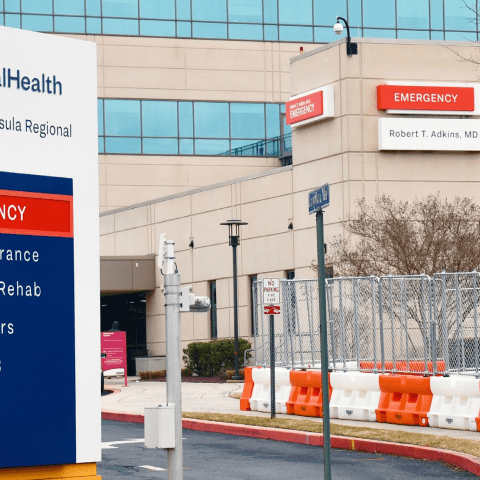
At TidalHealth, our emergency medicine team is available 24/7. We provide care around the clock, whether you arrive by land, sea, or air. Our emergency treatment spaces are equipped with on-site X-ray and diagnostic services to help us quickly address your needs. If your situation is life-threatening or requires advanced support, we will coordinate transfers and connect you with the care you need.
Our team includes physicians, nurses, technicians, and support staff, all trained to provide prompt and thoughtful care in urgent situations. Upon arrival, a triage nurse or allied health professional will assess the severity of your condition and determine the next steps. High-acuity patients are given a gown and bed for immediate evaluation and treatment. If your condition is less serious, we’ll guide you through a streamlined process to ensure timely care, often without the need for a gown or bed. Our team continuously monitors your condition to keep you safe and comfortable.
Both Salisbury, Md. and Seaford, Del. emergency departments are designated as Level III Trauma Centers by the American College of Surgeons. This means we are equipped to provide emergency care, resuscitation, surgery, intensive care, and stabilization for injured patients, delivering critical support when every second counts.
If you have questions about your care, don’t hesitate to ask. Our goal is to guide you through a stressful time and provide the support you and your loved ones need.
Additional Support
If you have had a sexual assault forensic exam and would like updates about the testing of your kit in Maryland, contact a Sexual Assault Kit Initiative (SAKI) Advocate through the confidential SAKI information line at 833-364-0046 or email [email protected].
TidalHealth Peninsula Regional and TidalHealth Nanticoke have both been recognized as Level III Trauma Centers by the American College of Surgeons. This designation reflects our ability to provide emergency services, including resuscitation, surgery, intensive care, and stabilization for injured patients. Our team is committed to delivering reliable, timely, and compassionate care in critical moments.
How do I know if I should go to the Emergency Department?
If you experience a serious or life-threatening symptom, such as chest pain, difficulty breathing, signs of a stroke, or heavy bleeding, call 911 or go to the Emergency Department immediately. Every second counts during heart attacks or strokes.
What happens when I arrive at the Emergency Department?
A triage nurse or trained team member will assess the severity of your condition. Based on your needs, you may be moved quickly to a hospital bed for closer monitoring, or you may follow a streamlined process if you don’t require admission. You will be closely monitored and may be moved to a higher level of care if your condition changes.
Who will be involved in my care?
Your care team may include physicians, nurses, physician assistants, nurse practitioners, technicians, and support staff. Depending on your situation, specialists in radiology, laboratory, or therapy may also be involved.
What if I have questions during my visit?
If you have any concerns or questions, ask a member of our team. We are here to support you and keep you as comfortable as possible during your care.
What should I do if my need is urgent but not an emergency?
For urgent, non-emergency care, consider visiting TidalHealth’s urgent care centers. For emergencies, always call 911.